
On Being Grateful for Crumbs: Women, Money, and the Helping Professions

Updated: May 12
A note from Kristy McConnell, R. Psych., Trauma of Money Practitioner, founder of Off the Beaten Path Psychology and Wellness
At Off the Beaten Path, a lot of the women we work with are in transition. Separation and divorce, career pivots, building or leaving a business, the parenting season changing, grief, identity shifts. We also work with a lot of business owners.
That means I spend my days moving between two kinds of rooms. The therapy room, where someone else is doing the inner work. And the business room, where I am doing mine. As a woman who is also a business owner, I have started to notice the same threads showing up in both. And one of the loudest is money.
In couples and divorce work, money rarely stays just a number. It becomes a story about worth, fairness, who got to study, who stayed home, who built the credit history. For many of the mothers I sit with, it does not end when the papers are signed. Sometimes the dynamics inside the marriage do not end with the marriage either. They just take new shapes. There is a particular fatigue in being expected to be grateful for what arrives while keeping a flawless paper trail, when the same standard does not seem to apply on the other side. And a particular grief in not being heard by rooms that are meant to listen. Untangling a financial life is rarely just legal. It is grief work.
In the business room, the research is consistent and uncomfortable. In one large study of online labour marketplaces, the median woman set a bill rate 13.5 percent lower than the median man, even when work category, experience, and education were accounted for (Foong et al., 2018). Women often do not apply for a job unless they meet nearly all of the qualifications, while men tend to apply when they meet around 60 percent (Mohr, 2014). Women are also less likely to ask for raises, and less likely to receive them when they do.
Different rooms. Same undertow. We have been socialized to be grateful for what we get.
That pattern has a name, or at least a useful one. Financial fawning.
What is financial fawning?
In trauma work, we talk about four nervous system responses to threat: fight, flight, freeze, and fawn. Fawning is the one where you keep yourself safe by pleasing, accommodating, and shrinking your ask.
When that shows up around money, it can look like under-earning even when you are skilled and busy. Apologizing for your fees, or quietly dropping them at the smallest sigh from a client. Saying yes to scope creep because saying no feels rude. Feeling guilt or shame around earning, especially when the work feels meaningful.
The Trauma of Money framework, developed by Chantel Chapman, names financial fawning as a response to systemic financial shame and a long history of being told, overtly or quietly, that wanting more is unbecoming. It can show up alongside chronic over-functioning, suppressed anger, and a deeply held belief that you are responsible for how everyone around you feels.
How women got here
Until shockingly recently, Canadian women could not vote, hold many professions, or own property without a man's name attached. Banks often required a male co-signer well into the 1970s and 80s. Women were told, again and again, that we could not be trusted with money.
I notice it even now in the "girl math" trend, where women laugh at themselves for the creative logic they use to justify a purchase. If I paid in cash, it was basically free. If I returned it, the refund is bonus money. The packaging changes. The message does not.
Then many of us walked into helping professions, where the script doubled down. The work is sacred. You are called to it. You should feel honoured. And the pay reflects what our society has historically decided care work is worth.
Some of us walked into businesses, or into marriages, where the same inheritance shows up wearing different clothes. The woman who underprices her offering. The woman who hesitates to name a number at the kitchen table. The woman who accepts a settlement she knows is low because the alternative feels louder than she can be.
You did not invent any of this. You inherited it.
Why "just charge more" or "just demand more" does not fix it
It is not really a thinking problem. It is a nervous system problem.
I describe trauma processing in EMDR like a paper shredder. A healthy nervous system is an industrial shredder, turning experiences into integrated memory. Trauma jams up the works. The papers, the messages we received about money, gender, and worth, sit stuck in the gears, fully intact and easily triggered.
You cannot affirm your way out of a body memory.
What actually helps
No tidy five-step plan. Three things I have seen help, in my practice and in conversations with women business owners and helping professionals.
First, name what is happening. The simple act of saying "this is financial fawning, and it makes sense given my history" lowers the shame considerably. Shame thrives in vagueness.
Second, work on the closest crocodile to the boat. In therapy, we do not try to heal every story at once. We start with the one that is biting right now. Maybe that is the panic before sending an invoice. Maybe it is the urge to drop your fee at the smallest hesitation. Maybe it is the shame that rises when you ask for fair child support. Maybe it is the freeze you feel the moment marital money comes up at the table.
Third, find people who can hold both. You need community that can hold both your competence and your tenderness around money. Both your ambition and your discomfort with ambition. Both the wish to be paid well, or paid fairly, and the conditioning that says wanting that makes you difficult.
Tomorrow, in Crossfield
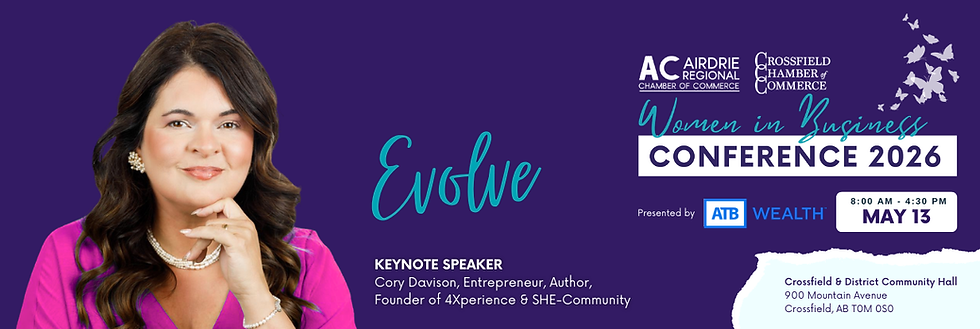
That last one is part of why we said yes to sponsoring the 2026 Women in Business Conference at the Empowerment level. Tomorrow, May 13, Jolene and I will be there in Crossfield, surrounded by like-minded women who celebrate women holding both. Both the work and the worth of it. Both the doing and the asking. We are very much looking forward to it.
This year's theme, "Evolve: From Potential to Power," lands right in the middle of the territory this post has been wading through.
The women who walk through our doors carry a lot. Many are themselves helping professionals, business owners, mothers, and people quietly wondering if they are allowed to want more.
You are. Not as a lucky exception, but because the work you do is real, the money you earn is yours, and gratitude does not have to mean smaller.
If something here itched a little, I hope to see you in Crossfield tomorrow. If you are looking for a quieter conversation, our team across Airdrie, Calgary, and Cochrane sees this work all the time.
We have come a long way from "women cannot be trusted with money." We still have work to do.
References & Further Reading
Chapman, C. (2025). The Trauma of Money: Mapping Compassionate Pathways to Healing Financial Trauma and Disempowering Financial Shame. Wiley.
Foong, E., Vincent, N., Hecht, B., & Gerber, E. M. (2018). Women (still) ask for less: Gender differences in hourly rate in an online labour marketplace. Proceedings of the ACM on Human-Computer Interaction, 2(CSCW), Article 53.
Mohr, T. S. (2014, August 25). Why women don't apply for jobs unless they're 100% qualified. Harvard Business Review. https://hbr.org/2014/08/why-women-dont-apply-for-jobs-unless-theyre-100-qualified
Kristy McConnell, R. Psych., is a certified Trauma of Money Practitioner and the founder of Off the Beaten Path Psychology and Wellness, with locations in Airdrie, Calgary, and Cochrane.